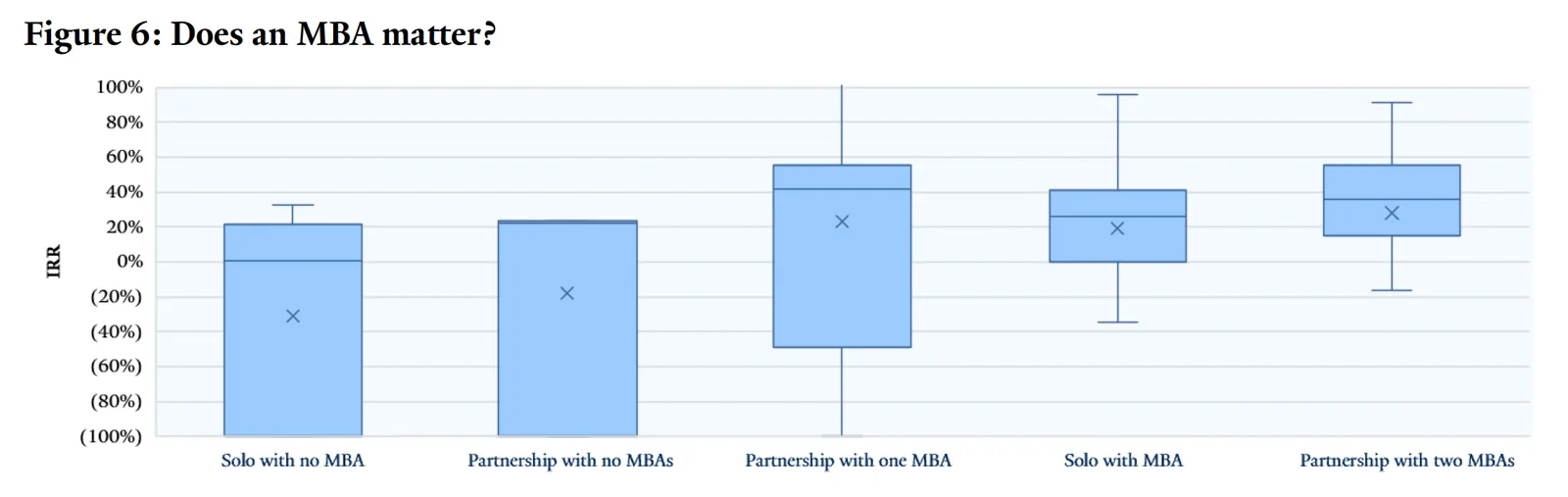
Turns out MBAs might(?) make decent general managers after all.
Yale School of Management studied 155 exited search fund investments and ran a multivariate regression to determine which CEO demographics were most correlated with investor returns.
My takeaways:
- The only statistically significant CEO demographic variable* was whether the searcher held an MBA (p = 0.02). Non-MBA searchers underperformed by ~25%pts of IRR. Having at least one MBA on the team increased median IRRs across both solo and partnered searches.
- Military experience, IB/PE/consulting backgrounds, and partnerships all showed positive relationships with returns in single-variable regressions. However, these disappeared once the full model controlled for other factors, suggesting they were at most statistically weaker drivers of performance.
- The specific MBA program didn’t appear to matter. The paper compared Harvard/Stanford entrepreneurs, vs entrepreneurs from the ‘M7’ group, as well as the ‘Top 15’ schools. It concluded: “There appears to be no critical difference in the ETA CEO IRR outcomes between Harvard and Stanford CEOs and other CEOs”.
That being said, this analysis was performed on a relatively small sample, and the model’s adjusted R^2 was just 0.11. The observed demographics explained ~11% of variation in returns. The other ~89% is presumably driven by other factors such as deal selection, execution—and presumably a bit of luck!
I suspect the MBA variable itself at least partly acting as a proxy for other unobserved factors (e.g. attributes that schools select for in the admissions process, pre-existing wealth, networks, etc.)
Note(s): (*) Geography was another statistically significant variable, however the authors decided that this was “not a demographic characteristic specifically associated with ETA CEOs in the same way as school or functional professional experience”.