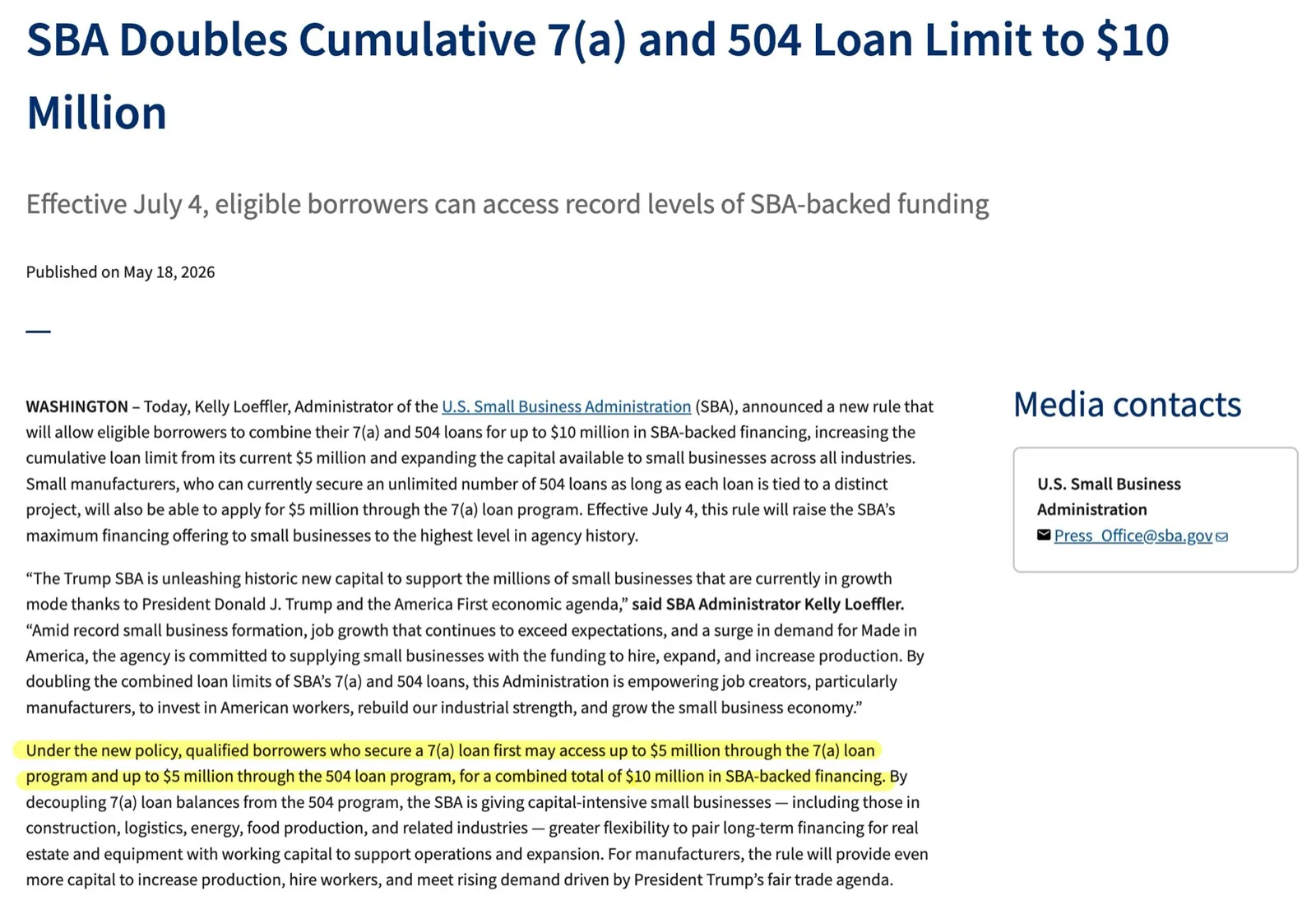
Last week, the SBA announced a decoupling of the lending limits between its 7(a) and 504 loan programs.
From 4 July, borrowers can combine loans from the two programs for up to $10M in SBA-backed financing (vs the previous $5M cumulative cap).
For Context
7(a) loans: the SBA’s flagship program. The SBA guarantees up to 75% of 7(a) loans (up to 85% for loans below $150K), used to finance working capital, equipment, real estate, or a business acquisition. Rates are capped, and any owner with 20%+ gives a personal guarantee (others may also need to provide guarantees, depending on deal structure).
504 loans: a separate program that provides long-term financing for major fixed assets only: owner-occupied real estate and heavy equipment. The structure of these is a bit more complicated, but the SBA essentially guarantees a part of these loans too.
What This Means
Previously, a borrower’s 7(a) and 504 balances were counted together against a single $5M cap—so the two programs were collectively capped at $5M. While the individual lending caps on each program haven’t changed, the new rule decouples these limits so that buyers can now ‘stack’ loans from each program.
For ‘Main Street’ deals, most transactions will still sit comfortably inside a single 7(a) loan, but for larger or more asset-heavy acquisitions, this change gives buyers a bit more breathing room.