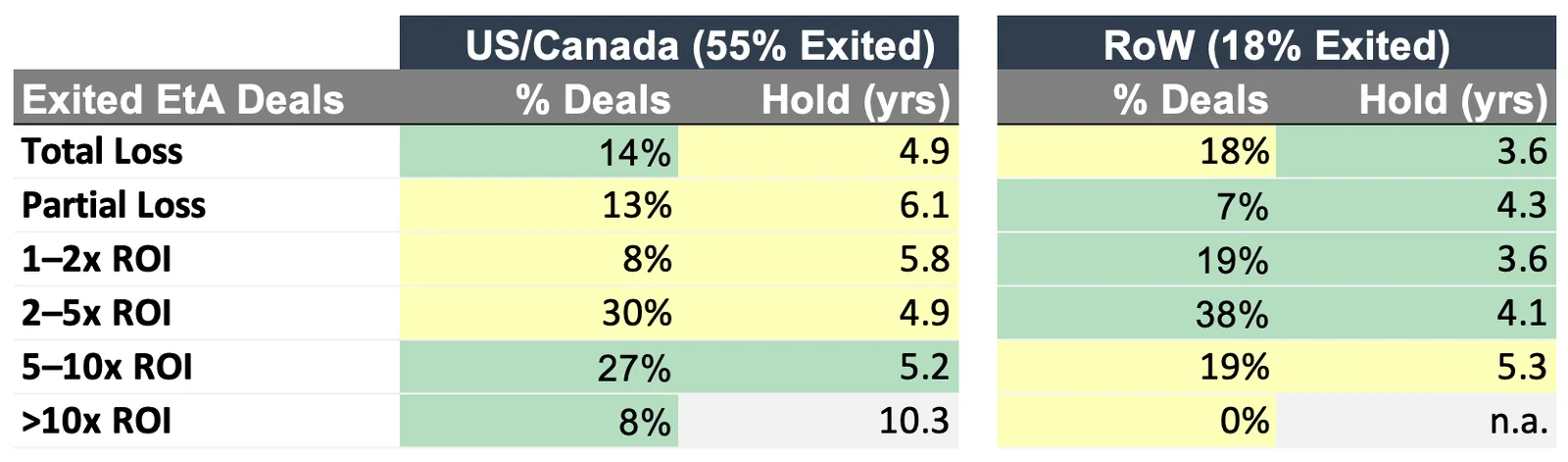
Comparing search fund outcomes across the US/Canada vs Rest of World markets using new data from IESE Business School and Stanford University Graduate School of Business:
1. The US Has Far More Exits
55% of US/Canada deals have exited vs. just 18% internationally. The obvious read is that the US market is more mature with better-developed exit pathways. But the simpler explanation might be vintage related—US search funds have been around longer, so more deals have had time to play out.
2. US Exits Take Longer, On Average
This one surprised me. Across almost every return outcome, US/Canada hold periods are longer than RoW (by ~37% on a weighted-average basis). You’d think the more established market would have more efficient exit timelines, vs slower ones. Perhaps more competition for quality exits, or operators holding longer to optimise returns?
3. US Returns Are More Concentrated in the Right Tail
35% of US/Canada exits deliver 5x+ ROI (vs. 19% for RoW). And 8% hit >10x—a category that hasn’t yet been recorded internationally. The US loss rate is comparable (27% total/partial loss vs. 25% RoW), so the outperformance is really about the winners winning bigger.
Will be interesting to see how this plays out as the RoW markets move up the maturity curve.