
The best time to sell your business is when you are ready, not when you think the economy is right. Analysis of more than 10,000 Main Street transactions shows that small business valuations have remained remarkably stable at roughly 2.5–3x Seller's Discretionary Earnings (SDE) for over a decade, regardless of GDP growth, stock market performance, or interest rate cycles. In 2024, the average small business sold for 2.57x SDE, according to the BizBuySell Insight Report, nearly identical to the average five years earlier. The data is clear: macro conditions do not meaningfully move Main Street valuations. What does move the needle is your personal readiness, your business's financial health, and how far in advance you plan your exit.
In This Article
- The Myth of Market Timing
- The Data: Small Business Valuations Are Surprisingly Stable
- What Actually Determines the Right Time to Sell
- How Far in Advance Should You Plan Your Exit?
- Signs You Are Ready to Sell
- Signs You Should Wait
- Frequently Asked Questions
The Myth of Market Timing
Many small business owners delay selling because they are waiting for ideal conditions: stronger economic growth, a rising stock market, lower interest rates. They assume these factors will boost their valuation and attract more buyers.
The problem? Data shows those conditions barely move the needle for Main Street businesses.
Across more than a decade of M&A activity, small business valuations have remained remarkably consistent at roughly 2.5–3x SDE. That stability has held through recessions, bull markets, interest-rate shocks, and COVID-era volatility.
In other words: the perfect market probably does not exist, and it does not need to. Unlike publicly traded companies, where valuations swing with investor sentiment, small business valuations are driven primarily by internal factors: cash flow quality, customer concentration, operational systems, owner dependency, and transition risk. These are things you can control. The S&P 500 and the Federal Reserve are not.
The Data: Small Business Valuations Are Surprisingly Stable
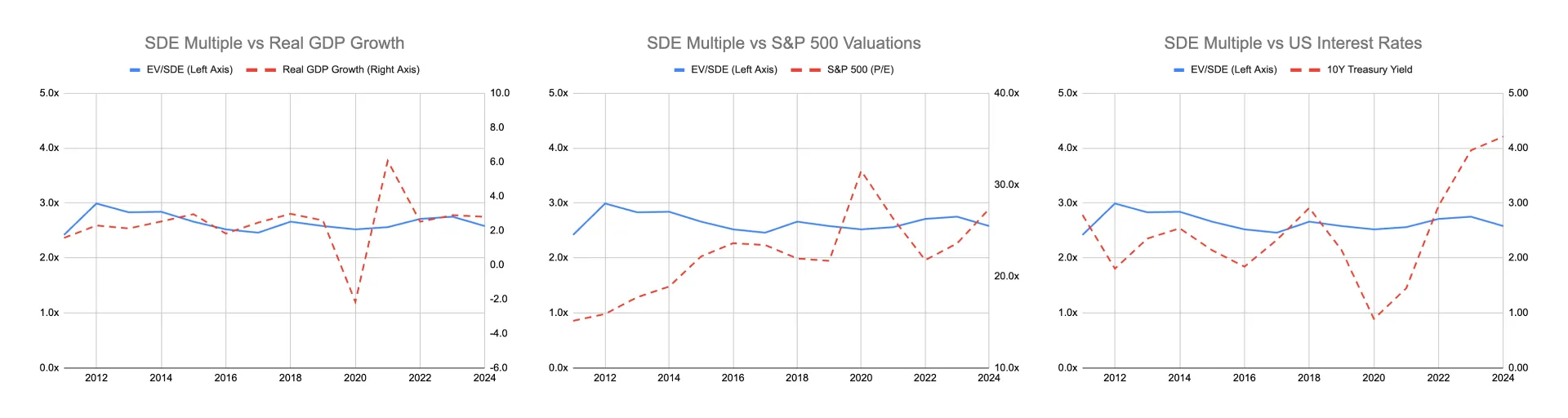
Analysis of 10,000+ Main Street transactions reveals a flat, predictable valuation trend. When you map average deal multiples against major macroeconomic indicators—U.S. real GDP growth, S&P 500 P/E ratios, and 10-year Treasury yields—three patterns emerge:
- Valuations are not tied to economic cycles. Even during major disruptions—COVID lockdowns, rapid recoveries, inflationary surges—multiples barely moved. Main Street deals remained within the 2.5–3x SDE range throughout.
- Valuations do not correlate with public markets. The S&P 500's P/E ratio has swung dramatically over the past decade, but small, privately held business valuations have shown virtually no relationship to stock market performance. According to the IBBA Market Pulse Survey, Main Street deal activity and multiples remained steady even during the 2022 market downturn.
- Valuations show limited sensitivity to interest rates. Despite the Federal Reserve raising rates from near-zero to over 5% between 2022 and 2024, transaction multiples did not materially compress. While higher rates can affect buyer financing costs, most Main Street transactions involve SBA-backed loans with relatively standardized terms, which mutes the impact of rate changes on deal pricing.
The BizBuySell Insight Report confirms this pattern: the median sale price and median revenue multiple for small businesses have remained in a tight band across multiple economic cycles. In 2024, the average SDE multiple across all industries was 2.57x, within the same range observed in 2018, 2019, and the years following the pandemic recovery.
What Actually Determines the Right Time to Sell
If the economy does not determine your valuation, what does? The factors that matter most are all within your control, and they fall into two categories: your personal readiness and your business's readiness.
Your Personal Readiness
- You have a clear reason to exit. Whether it is retirement, a career change, health considerations, burnout, or a desire to pursue a new venture, having a clear motivation matters. Owners who sell with conviction negotiate better and close faster than those who are ambivalent.
- You are emotionally prepared to let go. Many owners underestimate the emotional difficulty of selling a business they built from scratch. Sellers who have not processed this often sabotage deals during negotiation or due diligence without realizing it.
- You have a post-sale plan. Knowing what comes next—whether that is retirement, consulting, starting another business, or simply taking time off—reduces anxiety and keeps you focused on completing the deal.
Your Business's Readiness
- Consistent or growing financial performance. Buyers base their offers on the trailing twelve months of financial results, and most want to see at least three years of tax returns. A business with steady or improving SDE commands a higher multiple than one with volatile or declining earnings.
- Low owner dependency. If the business cannot function without you, buyers perceive higher transition risk, and they price accordingly. Businesses with documented processes, trained teams, and management that can operate independently are significantly more attractive to buyers and command premium valuations.
- Clean, up-to-date financials. Professional-quality financial statements—ideally monthly P&L statements, balance sheets, and tax returns prepared by an accountant—build buyer confidence and accelerate due diligence. Messy or incomplete financials are one of the most common reasons deals fall apart.
- Diversified customer base. If a single customer accounts for more than 15–20% of revenue, buyers will discount the valuation to reflect the concentration risk. Reducing customer concentration before going to market directly increases your business's value.
- Favorable lease terms. A transferable lease with several years remaining is a significant asset. If your lease is expiring soon or has unfavorable terms, negotiate a renewal before listing the business for sale.
How Far in Advance Should You Plan Your Exit?
The most successful business exits start with planning long before the business goes to market. Ideally, exit planning should begin 12 to 36 months before you intend to sell, giving you time to address weaknesses, optimize operations, and position the business for maximum value.
The IBBA Market Pulse Survey consistently shows that businesses with documented exit planning sell faster, closer to asking price, and with fewer deals falling through. Yet most owners start the process too late, often reacting to a life event rather than planning proactively.
A Practical Exit Planning Timeline
| Timeframe | What to Focus On |
|---|---|
| 24–36 months out | Get a preliminary business valuation to understand your baseline. Identify value gaps (owner dependency, customer concentration, deferred maintenance). Begin addressing them. |
| 12–24 months out | Clean up financials. Reduce owner involvement in daily operations. Strengthen your management team. Resolve any outstanding legal, lease, or compliance issues. |
| 6–12 months out | Engage a business broker or M&A advisor. Prepare your Confidential Information Memorandum (CIM). Set a realistic asking price based on market data. |
| 0–6 months | Go to market. Screen and qualify buyers. Negotiate terms. Complete due diligence. Close the deal. Maintain business performance throughout. |
Owners who follow this timeline avoid the most common mistakes: overpricing the business, entertaining unqualified buyers, and letting performance slip during the sale process.
Signs You Are Ready to Sell
Not every owner knows when the time is right. These are common indicators that it may be the right time to seriously consider selling:
- Your business is performing well: strong revenue, healthy margins, and a growing or stable customer base. Selling from a position of strength gives you leverage.
- You have been thinking about it for more than a year: if the thought keeps coming back, it is worth exploring. Prolonged ambivalence often leads to burnout, which damages both the business and its value.
- You have a life event driving the decision: retirement, relocation, health, divorce, partnership disputes, or a desire to cash out equity. These are legitimate triggers and happen more often than most people realize.
- The business can run without you, or could with modest adjustments over the next 6–12 months. This is the single biggest value driver in a small business sale.
- Your industry is consolidating: if larger companies or private equity groups are actively buying businesses like yours, market conditions may favor a premium valuation. Do not wait for the window to close.
Signs You Should Wait
Selling at the wrong time, even if the economy is strong, can leave significant value on the table:
- Financial performance is declining: buyers will use the downward trend against you. If performance has dipped, stabilize it before going to market.
- You just lost a major customer or key employee: this creates uncertainty that buyers will price into their offers. Rebuild first.
- Your financials are not in order: if you cannot produce three years of clean tax returns and monthly P&L statements, you are not ready. Messy financials slow down due diligence and erode buyer confidence.
- You have not reduced owner dependency: if the business depends entirely on you, it will be valued lower and harder to sell. Take 6–12 months to build processes and empower your team.
- You have no idea what the business is worth: going to market without a professional business valuation leads to misaligned expectations, the number one deal killer.
Frequently Asked Questions
When is the best time to sell a small business?
The best time to sell is when your business is performing well, your financials are clean, and you are personally ready to move on, not when you think the economy is "right." Data from more than 10,000 Main Street transactions shows that small business valuations have remained stable at 2.5–3x SDE regardless of GDP growth, stock market performance, or interest rate cycles. Focus on what you can control: your business's financial health, your level of owner dependency, and your personal readiness.
Should I wait for the economy to improve before selling my business?
Generally, no. Analysis of over a decade of Main Street M&A data shows that macroeconomic conditions—including GDP growth, stock market performance, and interest rates—have minimal impact on small business valuations. The average SDE multiple has stayed within the 2.5–3x range through recessions, bull markets, and rate shocks. Waiting for a "better economy" often leads to unnecessary delay, during which performance can slip, burnout can set in, or market windows in your specific industry can close.
How far in advance should I plan to sell my business?
Ideally, 12 to 36 months before you intend to go to market. This gives you time to get a baseline valuation, clean up financials, reduce owner dependency, strengthen your team, and resolve any outstanding issues. The IBBA Market Pulse Survey consistently shows that businesses with documented exit planning sell faster and closer to asking price.
How long does it take to sell a small business?
The typical small business sale takes 6 to 12 months from listing to closing. In 2024, the median time on market was 168 days, according to the BizBuySell Insight Report. The timeline depends on your industry, asking price, business size, and how prepared your financials and operations are. Businesses that are well-prepared before going to market tend to sell faster. For a detailed breakdown of the process, see our step-by-step guide to selling your business.
What makes a business ready to sell?
A business is ready to sell when it has consistent financial performance (ideally three years of clean tax returns), low owner dependency, a diversified customer base, a favorable lease, and documented operational processes. Clean, up-to-date financials accelerate due diligence and build buyer confidence. You can use our business sale checklist to assess your readiness, or try our free valuation calculator for a starting estimate of your business's value.
Do interest rates affect small business valuations?
Minimally. Despite the Federal Reserve raising rates from near-zero to over 5% between 2022 and 2024, Main Street transaction multiples did not materially compress. While higher rates can affect buyer financing costs, most small business acquisitions involve SBA-backed loans with relatively standardized terms, which mutes the direct impact on deal pricing. The bigger risk of waiting for lower rates is that your business performance or personal motivation may decline in the interim.