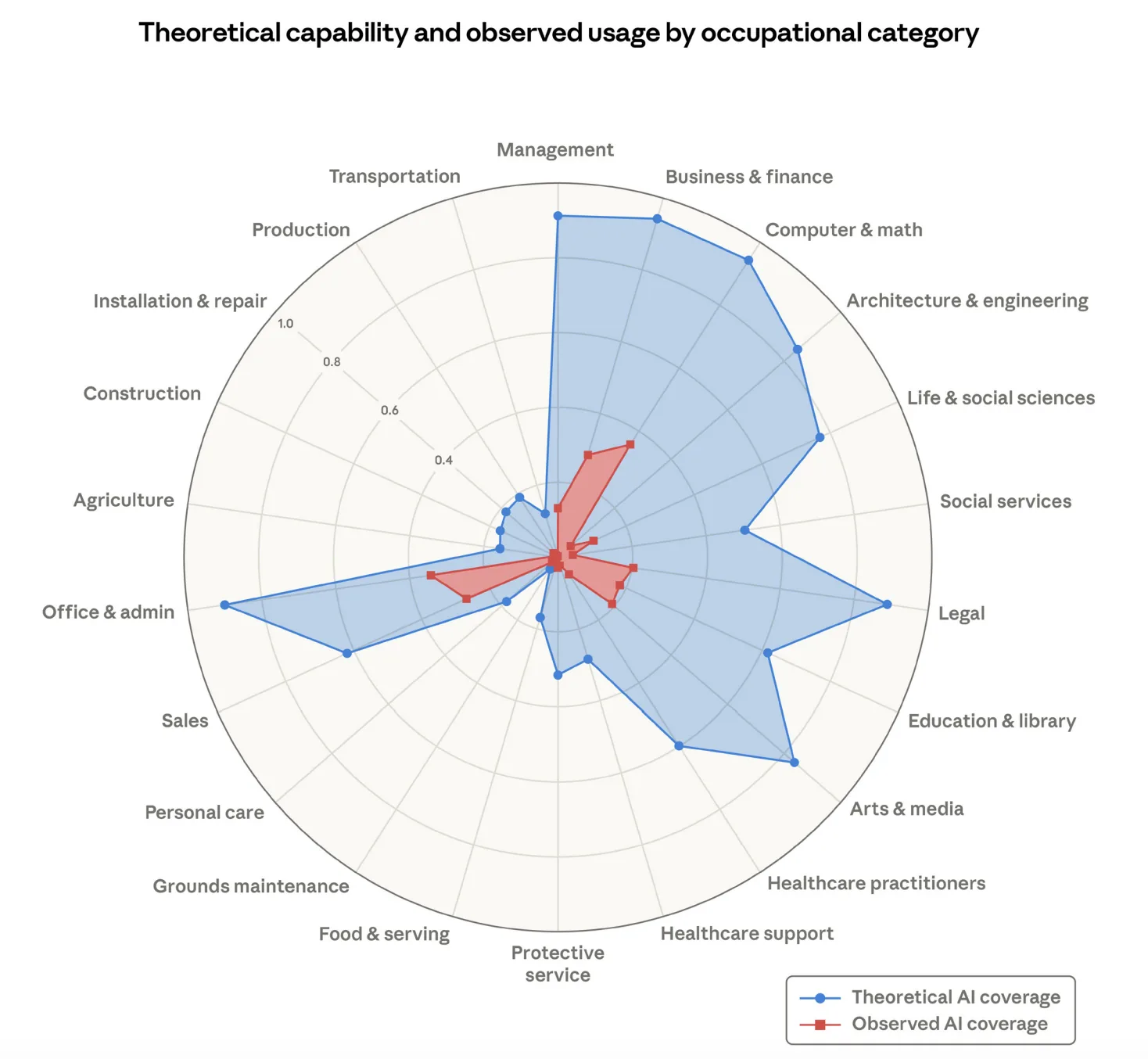
Anthropic dropped this chart a few days ago, showing:
Blue
‘Theoretical AI coverage’ of an occupation’s tasks, based on an academic study’s assessment of whether an LLM could complete each task at least twice as fast.
Each task within an occupation was given a discrete score based on whether/not an LLM could complete the task at least twice as fast by itself (B = 1) or with additional tools (B = 0.5). These tasks were then weighted by the estimated amount of time spent on them in each occupation, to arrive at the ‘blue’ value.
A score of 1.0 means that 100% of tasks can be completed by a standalone LLM at least twice as quickly. Lower scores could have multiple interpretations.
Red
‘Observed AI coverage’, based on actual Claude usage data tracked by Anthropic.
Each task was given a value of either zero (if there was insufficient Claude usage for a given task), or a value between 0.5 and 1, based on the extent to which said task was completely automated. These tasks were again weighted by the estimated amount of time spent on them in each occupation, to arrive at the ‘red’ value.
A score of 1.0 would mean that every task in the occupation is both theoretically feasible and seeing fully automated Claude usage. Again, lower scores could have multiple interpretations.
Some Thoughts
While these measures are a bit difficult to internalise, and not directly comparable (I think there are some cases where Red > Blue), they do provide a directional sense of AI usage in the workforce.
Obviously there is still a very large gap between observed and theoretical coverage. I suspect at least part of this gap is driven by:
- AI literacy within a given occupation (computer/math occupations are likely to have greater AI literacy)
- Regulatory and licensing constraints (healthcare occupations are more likely to have restrictions on AI usage)
- General bureaucracy (large corporate employers may be slow in adopting AI at scale)
- Model choice (Anthropic only measures Claude usage, not GPT/Gemini/other models)
Notably, a few of the categories with near-zero theoretical and observed AI coverage—construction, installation & repair, grounds maintenance—have been anecdotally popular industries for search funds and small business acquirers.
I wonder whether this will start showing up in deal multiples. If buyers increasingly price in AI displacement risk for white-collar-adjacent businesses, the relative attractiveness of trades and services businesses could increase meaningfully.